Here are the final project websites and blogs posted by my students:
Kids CrossingWebsite and
blogIn this game for kids that challenges math and language skills, two players race to get all of their animals across the board while answering math word problems. I really liked this game concept and this team worked very hard at realizing the final project. It was one of the few games aimed at children, and the only one with educational value. I was especially impressed by the children's story book that accompanies the game and provides the narrative explanation for why the animals want to move from one side to the next. I was critical of an early draft of this game and suggested that they make it more realistic -- creating a story, perhaps, where two goat-herders are competing to get to the Spring meadow the fastest. I always prefer games that map onto reality, so that the game also teaches you something about real systems. Or you might have the story be more abstract and math focused -- where intergers have to move from the land of negative numbers to the land of positive numbers or something like that.
In the end, I admired this team for sticking to their vision and working to justify their choice of a more whimsical approach than I had encouraged -- even providing the story book to fill in the narrative details. The pictures of the game pieces featured in that book are very cute, and it was a good solution to the problem of providing illustrations.

I found the game very fun and playable and thought the basic concept was excellent. They'd have to do some market testing, but I think with some modifications this could be a successful game. I had just a few points of criticism and commentary:
- I like that math is also incorporated into the rolling of the dice, where the lowest number is subtracted from the highest to arrive at the number of moves for that turn. The only problem, though, is when players roll a double, in which case the score is zero and they basically lose a turn. I think this slows the game down a bit and could frustrate children. I may be wrong about that, but it might present an opportunity to add another element of luck to make this potentially frustrating moment a fun one instead. One thing I suggested to the team was that when players rolled a double they could be allowed to choose a "Chance" card that could be either positive or negative. There may be circumstances (such as the double roll or when they land on certain spaces) where players would have a choice whether or not to take the chance.
- I rather dislike rule cards, personally, as in the frog rules, where someone has to do or say silly things at each turn or under certain circumstances (e.g.: whenever a three is rolled). I just find them annoying, and I found that as I played the game we just forgot about them after a while. I suppose one rationale for them in the present game is that kids have to learn to abide by rules and they can help focus your attention on details. But the rules are purely arbitrary, and I think kids have too many arbitrary rules to abide by already -- and it is easy for them to perceive things like math as too rule bound. You'd have to market test it and see how young players feel. But personally I don't think they add much to the game, despite the fact that the frog himself is amusing.
- The educational cards that teach something about animals are an intriguing touch. But I think they might be more focused on the topic at hand and offer instead some math vocabulary (difference, sum, etc.) and maybe some tips on speeding up calculations or solving word problems more easily. That would enrich the educational value of the game a bit and make it more appealing to math educators.
- Ultimately, this is a race game, not very different from Candy Land but with a very rich math and language learning element added to it -- and a lot of whimsical animals. I could do without the whimsical animals and just make it more math focused. I think making it a math and word problem game at every level would make it more appealing to educators.
- Some of the specific questions might be too easy or too hard and should be tested on kids. But that is a minor issue.
Supernova!Website and
blogSupernova! features one of the best board designs -- likely because the board was the first thing this group came up with! This game expands on the group's earlier success with "Sibling Rivalry" but sets the competition in outer space. This is a very fun party game, mostly because it makes people do silly and embarrassing things. It really does get you exploding out of your seat.

This game made me realize that next year I will have to do more to discuss party games since this is the age group that responds to them. This one has an attractive game board and some very imaginative and amusing questions and tasks. I think some of the core concepts are very good and with a little more work they could have something more fully coherent. In the end, though, this is definitely a fun game.
DiscoveredWebsite and
blogThe game for people who want to be a star. Players move around the board and gain money by responding to one of three challenges presented by cards they draw at each turn (depending on what space they land on). The cards offer three possible questions, each worth different monetary values. There is a trivia question, worth the most. There is a chance to act out a scene from a movie or TV show. And there is a low-paying but easy general opinion question (so that you are always earning a little money on each turn). The first player to collect a million dollars wins the game. It is sort of like Monopoly meets Trivial Pursuit Silver Screen Edition with some other interesting elements thrown in.
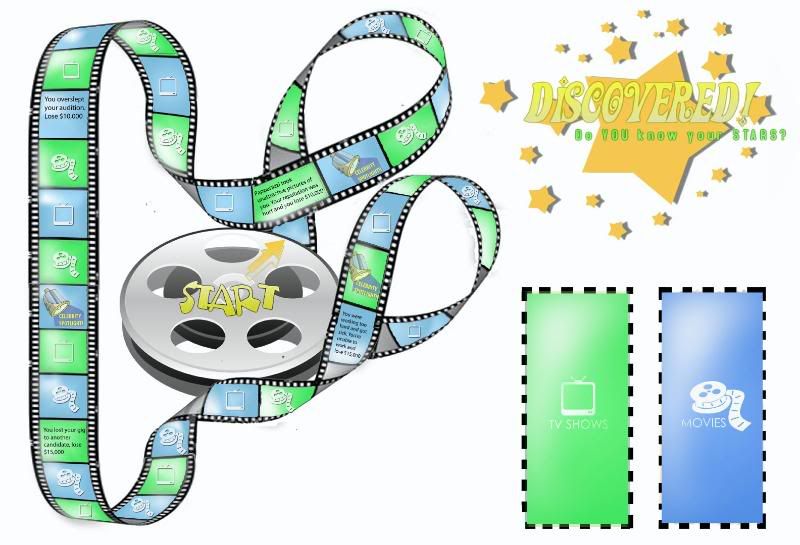
I thought this was a somewhat coherent game with a lot of promise, if they had only done another revision to make it more coherent or to think through the specific questions a bit more. I thought the game board was very attractively designed and fun. I thought the card designs and the idea of offering three possible ways of scoring at each turn was smart. Ultimately, I think this game does not have a lot of market potential and is not very fun to play. But it was well designed (especially the board and the money) and a lot of work went into it.
I had some reflections and then some specific criticisms:
This game made me think a lot about whether trivia games are basically dead. The success of Trivial Pursuit is often attributed to the fact that it arrived on the scene just as the baby boomers came of age to buy a party game. The reason the game appealed so much to baby boomers is because they were the last generation to have a shared knowledge of movies, television, history, and news events. They all watched the same shows or had familiarity with them. The boomers came of age at a time when hit TV shows could capture 50-75% of the viewing audience. They lived at a time before movie multiplexes, where films stayed for a couple of weeks at the theater and everyone eventually saw it -- or they saw it on Movie of the Week when it came to TV. I could go on -- but basically, this was the last generation with a shared culture of trivia knowledge that many aware people with a good memory would be expected to know. Today, however, is very different. The entertainment and TV market is much more fragmented -- to the point where there just is not a shared culture of knowledge. Even the most popular TV shows are lucky to get 10% of the audience. Hit movies for one subsection of the audience could remain completely unknown to another segment. African Americans and anyone over 30 has probably never heard of Michael Cera, for instance. And not everyone grew up watching every Disney movie that came to market.
- So I think movie and TV trivia games are basically a non-starter or slow-starter in the marketplace today. They may not be completely dead, but I think they are not going to be very popular unless they tap into a sub-group with some shared knowledge. I think this game had that potential, but to really make it succeed they would have had to interview or play-test with a group of aspiring actors or something like that. What facts, people, scenes, or information do the majority of aspiring actors feel obliged to know? I think you might do better with that -- and if players don't know it, at least they will feel like they should...
- It may well be that this game reaches toward such a subgroup of middle-class Gen-Ys of college age, but I'm not so sure. The trivia and performance questions are simply obscure to many people. What's more, the obscurity is compounded by the way that the questions are asked -- so that players often have to know very specific details about characters, films, or actors in order to get the questions right. The cards seem to say: "You might have seen the movie -- but did you pay attention to the names of the minor characters?" I think you'll be lucky if 10% of your potential market has seen the movie. Don't push your luck that they remembered the name of a minor character. That is absurd and is bound to turn people off.
- Though I found the board design good, I also think it is anachronistic. Films are increasingly going digital and it won't be more than a few years before traditional film completely disappears. It might take only a decade before young people completely fail to recognize the board's depiction of "film" as being equivalent to the digital movies they downloaded in their youth... But I think that fits with the anachronistic problem of the game generally.
- The game concept is intriguing, but it could have been pursued in a way that made it more coherent. My suggestion is always to try to map the game onto a real system -- and in this case maybe that system is how people become a star of the big or little screen in real life. I don't think you become a star by answering trivia questions -- and definitely not by answering opinion questions. Rather, you become a star by having some talent, honing your craft, and then getting a lucky break where you can shine because both producers and then audiences respond to your performance. If you look at the Hollywood star system as a model then perhaps a better design for a game like "Discovered!" would present a board designed after the Hollywood Walk of Fame -- or, better yet, a bunch of audition opportunities. At each audition you are asked to demonstrate some talent -- whether singing, dancing, or acting. The other players (who represent the audience or the producers) would have to respond. Perhaps if one of the other players recognizes the scene you are performing, or can name the actor you are imitating, both you and that player score points that round. If they fail to identify the scene or character, then you still get some "experience" points for trying. Once you have a certain number of points, you are ready to be discovered -- but you will still have to wait for your lucky break to come along. Perhaps there could be star-making opportunity spaces on the game board -- and once you have accumulated enough points, you are ready to be discovered on that turn -- whereas until you have the required number of points it acts as just another audition. You might still have various scoring opportunities on each card -- but the scores would be based on talent, with the most points going to singing a song, then acting a scene, and finally telling a joke. With the joke -- if you make anyone laugh then you score some points that round. That's a loosely formed idea yet, but I think the concept is more coherent than that of the present game because it more fully maps onto the real world.
- The money element adds a bit of annoyance to the game -- rather like the more annoying element of Monopoly, where you need a banker and someone to do the accounting. While players attracted to the business situation of Monopoly might not mind some accounting, most would-be actors likely would not enjoy it as much.
Are You Talking to Me?Website and
blog - This group took one of their midterm games and turned it into a fun game for macho guys. There were lots of fun social elements and the game was fun to play, with lots of amusing ideas.
 My main criticism at midterm was that there was not much room for women to play -- but they responded to that by incorporating female characters. It was revealing that one of their play test groups had two women, both of whom liked it.
- My biggest criticism is of the play board itself, which really should have been redesigned in order to make it easier to accommodate the player pieces on each square.
- I also thought that the play pieces could have been better chosen or better constructed to fit the set.
Journey through the StarsWebsite and
blog.
This game creates a carnival atmosphere, with kids playing verious games of skill in order to advance in their quest to collect all of the planetary keys and unlock the box to buried treasure. This game had some promising elements, but I thought it was finally under-developed and its promise unrealized.

Basically, this group took on nine planets and ended up with only four. Also, the game boards for each planet are not reproducible.
- I very much like the idea of having skill-based games be central to whether or not players can advance, and I was very glad they picked up my suggestion that they use purchased games as a way of doing that -- perhaps creating for themselves some cool cross-marketing opportunities. These two core concepts are the most promising elements here, but the final execution is lacking.
- The story concept, featuring space pirates and buried treasure, seems hard to take seriously. They could have come up with a better reason why players had to visit each of the nine (or eight) planets.
- I did approve of them just doing game boards for a few planets, but I expected the game boards themselves to be more fully elaborated. In the end, they just present you with pictures of each planet and you are supposed to craft the remainder.
- I think they should do away with turns and just have you compete to get through the game as quick as possible.
- My best suggestion to this group is that they should reconceive the game as a Big Urban Game or as a children's party game. Basically, they could have a game board that resembled a giant Twister game that you spread out in the living room or even the yard. The various play stations are depicted on the board and players literally race to collect a card from each showing their completion of they game.


